


Iluminace 2025, 37(3):109-118 | DOI: 10.58193/ilu.1820
Hussein Shariffe’s Filmic Ruins: Archival Noise and The Dislocation of Amber (1975)
 ORCID...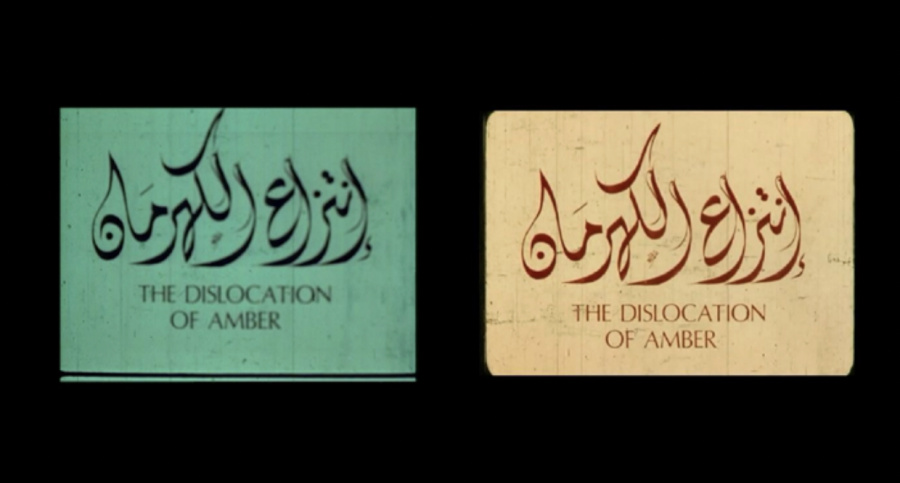
My audiovisual essay explores Hussein Shariffe’s The Dislocation of Amber (1975) as a filmic “ruin” within his archive. Described by collaborator Sondra Hale as “Sudan’s first art film,” The Dislocation of Amber was filmed in the Sudanese city of Suakin, which lies in ruins. The available digitised copies of the film are degraded and disrupted by noise. Hale interprets the film as “a metaphor for a society decimated by colonialism,” and this essay uses Shariffe’s approach to the ruins of Suakin as a model for how to approach the ruins of Shariffe’s film itself, along with the political and personal histories that entwine around this material object. I pay close attention to the degradation of the images in Shariffe’s film to open up questions about the political realities of Sudanese cinema. This videographic scholarship is influenced by Jiří Anger’s “film theory from below”: a speculative and concrete way of thinking about images through images that “inherently depends on the material qualities of the digitised objects, the traces and gestures embedded in the individual frames and between them.” If the film’s future is one where restoration can help gain a larger audience for this extraordinary work, it is also vital to mark this moment of its material history, to stay with the noise and retain its loss as an index of political contingencies.
Keywords: Sudan, archives, noise, experimental, ruins
Received: May 2, 2025; Revised: November 1, 2025; Accepted: November 23, 2025; Published: February 3, 2026 Show citation
Download citation
References
- "Activating the Exile Archive: Hussein Shariffe between London, Cairo and Khartoum," King's College London, September 3, 2024, accessed October 8, 2025, https://www.kcl.ac.uk/news/spotlight/activating-the-exile-archive.
- Anger, Jiří. Towards a Film Theory from Below: Archival Film and the Aesthetics of the Crack-Up (New York: Bloomsbury, 2024).
 Go to original source...
 - Beeston, Alix, and Stefan Solomon, eds. Incomplete: The Feminist Possibilities of the Unfinished Film (Oakland: University of California Press, 2023). Go to original source...
- "Canyon Cinema Discovered," accessed October 8, 2025, https://canyoncinema.com/wp-content/uploads/ccd-final-web.pdf.
- Carter, Erica, and Laurence Kent. "An Infinity of Tactics: Hussein Shariffe's archive in motion," L'Atalante: Revista de estudios cinematográficos, no. 28 (2022), 115-136.
- Carter, Erica. "The Eloquence of Odradek: Hussein Shariffe's Exilic Film Objects," in Accidental Archivism: Shaping Cinema's Futures with Remnants of the Past, eds. Stefanie Schulte Strathaus and Vinzenz Hediger (Lüneburg: Meson Press, 2023), 243-252.
- César, Filipa. "Cine-animism: The Return of Amílcar Cabral and Many Returns," in Accidental Archivism: Shaping Cinema's Futures with Remnants of the Past, eds. Stefanie Schulte Strathaus and Vinzenz Hediger (Lüneburg: Meson Press, 2023), 455-477.
- Cherchi Usai, Paolo. "The Lindgren Manifesto: The Film Curator of the Future (Italy, 2010)," in Film Manifestos and Global Cinema Cultures, ed. Scott Mackenzie (Oakland: University of California Press, 2014), 558-559.
- "Cimatheque, Remastered Open Call," accessed April 30, 2025, https://cimatheque.org/remastered.
- Deegan, Marilyn. "Cultural Destruction and Rescue in Sudan: The Sudan Memory Project," Journal of Art Crime, no. 33 (2025), 43-65.
- Dirckinck-Holmfeld, Katrine, and Pepita Hesselberth. "Ledgers and Legibility: A Conversation on the Significance of Noise within Digital Colonial Archives," in Legibility in the Age of Signs and
- Machines, eds. Pepita Hesselberth, Janna Houwen, Esther Peeren, and Ruby de Vos (Leiden: BRILL, 2018), 243-262.
- Editor. "From Ruin to Resilience: Sudan's Archival Restoration," Andariya, September 12, 2025, accessed October 8, 2025, https://www.andariya.com/post/from-ruin-to-resilience-sudan-s-archival-restoration.
- Fenwick, James, Kieran Foster, and David Eldridge. Shadow Cinema: The Historical and Production Contexts of Unmade Films (London: Bloomsbury, 2020). Go to original source...
- Hale, Sondra. "Hussein Shariffe (1934-2005): Exile and homecoming between London, Cairo and Khartoum. Panel 2 - The City as Metaphor: The Dislocation of Amber" (online presentation),
- December 19, 2025, accessed October 8, 2025, https://germanscreenstudies.wp.st-andrews.ac.uk/2020/12/19/hussein-shariffe/.
- Hale, Sondra. "More than a Grain of Sand: Opening Outward - Sudanese Thought in a Globalized Milieu," in Sudanese Intellectuals in the Global Milieu: Capturing Cultural Capital, eds. Gada Kadoda and Sondra Hale (London: Rowman & Littlefield, 2022), 3-18. Go to original source...
- Hale, Sondra. "The Making of the 'Dislocation of Amber' - Sudan's First Art Film," Sudan Studies Association Newsletter 20, no. 2 (2001), 16-19.
- Jancovic, Marek. A Media Epigraphy of Video Compression: Reading Traces of Decay (Cham: Palgrave Macmillan, 2023). Go to original source...
- Macdonald, Marie-Paule. African Cinema and Urbanism (London: Anthem Press, 2024). Go to original source...
- Malaspina, Cécile. An Epistemology of Noise (London: Bloomsbury, 2018). Go to original source...
- Meden, Jurij. Scratches and Glitches: Observations on Preserving and Exhibiting Cinema in the Early 21st Century (New York: Columbia University Press, 2021).
- Reid, Bill. "Out of the Silence," in Solitary Raven: The Selected Writings of Bill Reid, ed. Robert Bringhurst (Vancouver: Douglas & McIntyre, 2000), 71-84.
- Roden, David. "The Twentieth Century Decline of Suakin," Sudan Notes and Records 51, (1970), 1-22.
- Sabiescu, Amalia G. "Living Archives and The Social Transmission of Memory," Curator 63, no. 4 (2020), 497-510. Go to original source...
- Schuppli, Susan. Material Witness: Media, Forensics, Evidence (Cambridge: The MIT Press, 2020). Go to original source...
This is an open access article distributed under the terms of the Creative Commons Attribution 4.0 International License (CC BY 4.0), which permits use, distribution, and reproduction in any medium, provided the original publication is properly cited. No use, distribution or reproduction is permitted which does not comply with these terms.